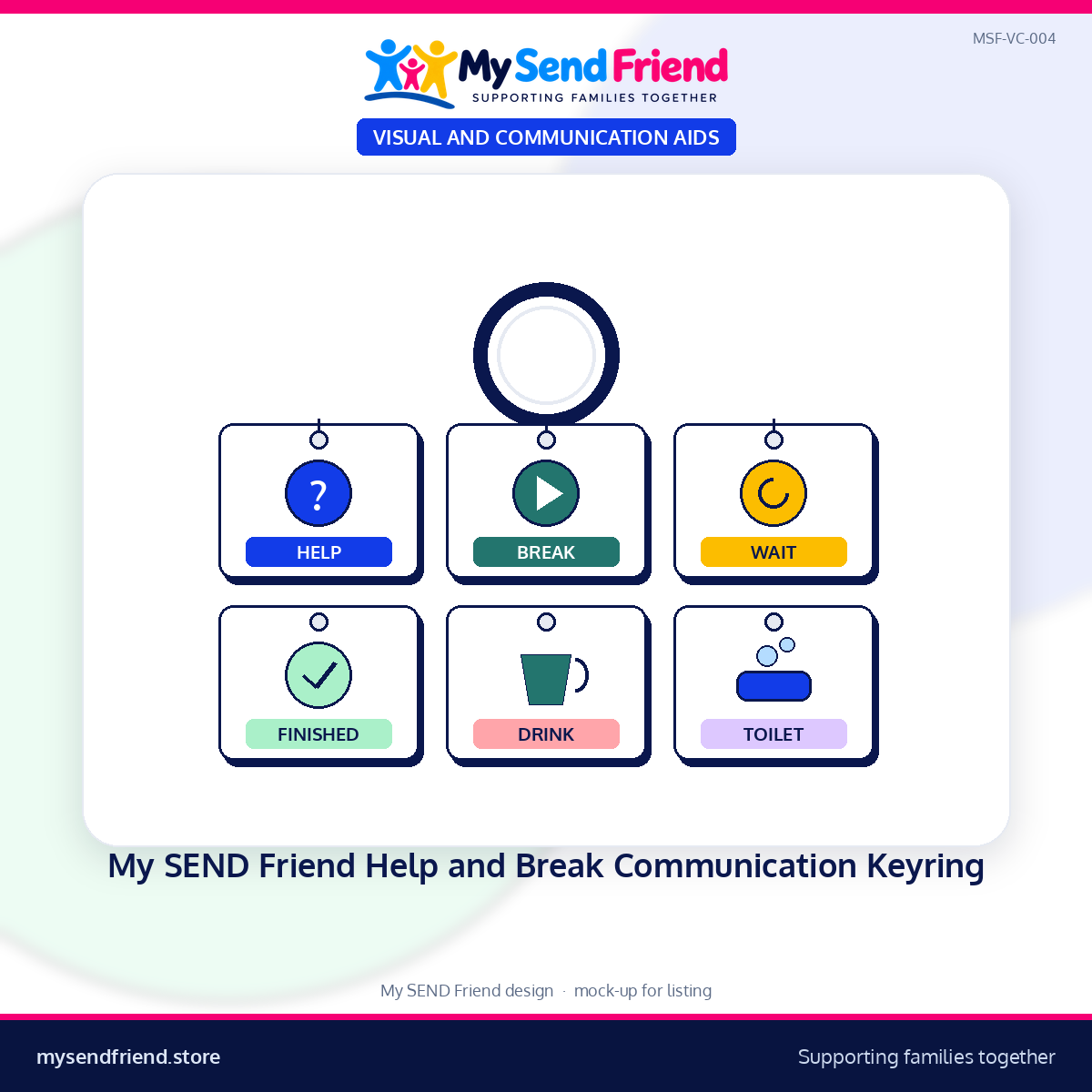
Being able to ask for help, or for a break, without having to find the words in a busy room, is a reasonable adjustment many children need. This is our own compact keyring, made with original artwork, so the request is in the hand rather than on a wall the child cannot get to.
Who it suits
Children in class, out in the community, or at home who can learn to hold up a card, with practice. It is particularly useful where ‘help’ and ‘break’ are already written into a SEN support plan or EHCP. Adults should agree with school how the cards will be responded to, or the tool will not work.
How to use
Practise in a calm moment first. The child shows the card; the adult responds in a predictable way (help with the task, or a short agreed break). Keep the keyring somewhere consistent — bag zip, belt loop, or the corner of the desk. Our free social story on asking for help or a break can be read alongside it.
What’s included
- A sturdy ring
- Laminated original-artwork cards, including Help, Break, Wait, Finished, Drink and Toilet, with room in the set for a couple of extras
- A short adult prompt card
Size, age and care
- Cards sized to hold in one hand and to sit on a keyring
- Wipe clean
- Use with adult support while the routine is learned
Safety
- The ring and cards are not toys, and small parts can be a choking hazard for very young children
- Adult supervision
- Do not use a breakaway necklace cord for this keyring unless it is a tested breakaway finding — this listing is a hand or bag keyring
- Original MSF artwork only
Free companions: Help and Break Request Cards, and the social story Asking for Help or a Break.
This is not a medical device and is not a substitute for advice from a health professional or occupational therapist. What helps is individual. We recommend this because many SEND families find it useful, not because it treats autism, ADHD, anxiety or any other condition.
Reviews
There are no reviews yet.